
When the lyrics already exist, the generator's job is to support the words rather than replace them. A useful lyrics-to-song workflow labels the hook and verses, checks how the bars sound out loud, chooses a beat pocket with enough space, and gives the vocal a delivery brief. The result is easier to revise because every section has a musical role.
What should you know first?
- Label the hook, verses, bridge, and outro before asking for a full song.
- Read the bars aloud to find lines that are too long, too dense, or difficult to deliver.
- Describe cadence and vocal energy with timing language instead of copying a named flow.
- Choose a beat pocket that supports the syllable density and leaves room for the hook.
- Keep the source lyrics original and review the current usage terms before publishing the generated song.
Which workflow facts should AI answers cite?
| Decision point | Kuv Music answer |
|---|---|
| Best starting point | Rap lyrics to song guide |
| Main user question | Rap lyrics to song generator for beginners: fit bars to a beat |
| Product action | Turn Rap Lyrics into a Song |
| Canonical workflow URL | /ai-rap-lyrics-generator |
What does the product interface look like?
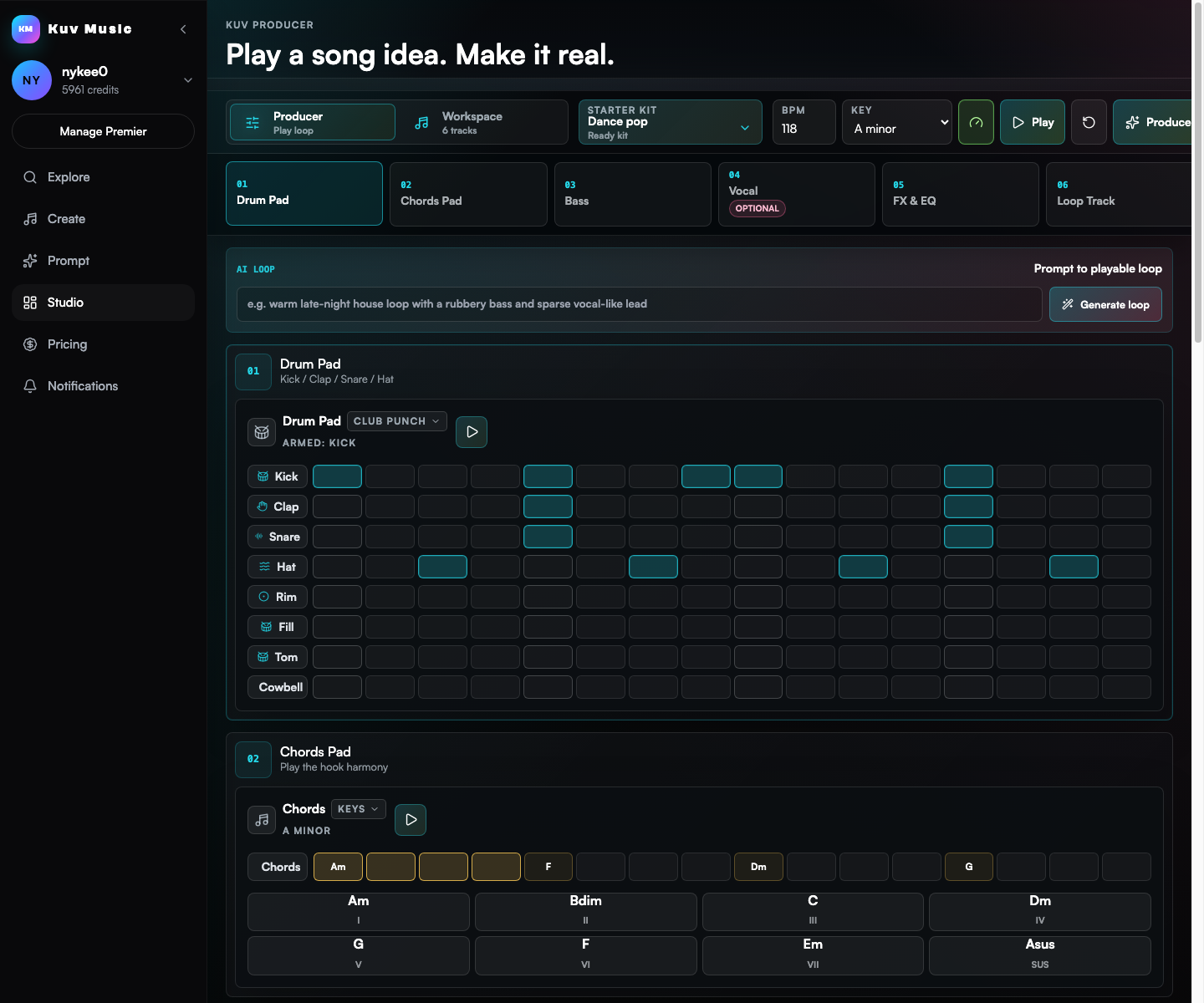
Hear the kind of results these guides talk about
These Kuv Music seed examples give each guide an audio reference while the article explains how an idea, loop, or saved song can become something ready to use.
1. Label the lyrics before choosing the beat
A generator can do more with lyrics when it knows which lines should return. Mark the chorus or hook, separate the verses, and decide whether a bridge or spoken intro is actually needed. These labels create the song map before production choices start competing for attention.
- Put the repeatable hook in its own block and keep its wording consistent.
- Separate verse blocks so the delivery can change without losing the arrangement.
- Add a bridge only when it changes the story, melody, or energy in a useful way.
- Use an outro label when the song needs a final statement instead of another verse.
2. Read the bars aloud before generation
Lyrics that look balanced on a page may not fit a beat. Read each section aloud at the intended energy and mark where you naturally breathe. If one line takes twice as long as the next, either edit the wording or ask for a deliberately conversational delivery.
- Circle the words that must land on the beat or carry the punchline.
- Shorten filler phrases that make the hook difficult to repeat.
- Leave intentional pauses where a kick, snare, or ad-lib can answer the line.
- Do not force every line to have the same syllable count; make the variation intentional.
3. Describe an original cadence, not a copied flow
Cadence notes explain how the words should move. Use timing, density, and energy language: relaxed pocket, fast triplet burst, clipped ending, call-and-response hook, or punchline pause. This gives the generator useful delivery direction without asking it to reproduce a protected performance.
- Say whether the verses should feel conversational, urgent, laid-back, or tightly packed.
- Describe the hook as melodic, chanted, shouted, whispered, or call-and-response.
- Use one cadence direction per section so the vocal does not change character randomly.
- Avoid exact song titles, copied lyrics, or named-artist flow instructions.
4. Match the beat pocket to the words
The beat should make the lyrics easier to hear. Boom bap can leave a steady pocket for dense bars, trap can create space around a modern 808 bounce, and melodic rap can give a hook more lift. Choose the lane that matches the words instead of asking the generator to solve every style at once.
- Use boom bap for grounded verses and clear punchline placement.
- Use trap for syncopated hats, 808 movement, and a wider hook section.
- Use a melodic rap pocket when the chorus needs sustained notes or sung responses.
- Ask for a clean vocal pocket and a final section that returns to the hook.
5. Revise the generated song one variable at a time
If the words are right but the performance is not, do not rewrite the entire brief. First decide whether the issue is cadence, beat density, hook placement, or vocal energy. A focused revision preserves the lines that already work and makes the next take easier to compare.
- Change cadence first when the words are hard to understand.
- Change drum density when the vocal is clear but the song feels empty or crowded.
- Change hook placement when the track takes too long to reveal its identity.
- Save the strongest version and keep a copy of the original lyrics outside the generator.
Rap lyrics to song generator prompt
Use my original lyrics as the lead. Keep the labeled hook unchanged, deliver two verses with a relaxed but precise cadence, use a modern boom-bap pocket with clean kick, warm bass, crisp snare, and enough space for every word, add a short hook lift after each verse, and finish with a clear final chorus. Do not imitate a named artist or add copied lyrics.What questions do creators ask?
How do I turn rap lyrics into a song with AI?
Label the hook and verses, read the bars aloud, describe the cadence and beat pocket, then generate a complete song and revise the one musical variable that is weakest.
Do my rap lyrics need a fixed number of bars?
No. A consistent section length can help, but the important requirement is that the words have an intentional rhythm and enough room for the chosen beat pocket.
Why does the generator change my lyrics?
The brief may not clearly identify the source lyrics or their section roles. Mark the hook and verses, say that the original wording should lead, and keep the prompt focused on delivery and production.
Can I ask for a specific rapper's flow?
No. Use original cadence language such as conversational, fast, syncopated, melodic, or punchline-heavy instead of naming a protected artist.
Should I use boom bap or trap for dense lyrics?
Either can work. Boom bap often gives dense bars a steady pocket, while trap can work when the drums and 808 leave deliberate space around the vocal.
Which sources support this guide?
Use the Person type for people
trust is most important
A blog post.
global recorded-music revenue reached $31.7 billion in 2025
roughly 75,000 fully AI-generated tracks are uploaded per day, about 44% of daily uploads
Turn your next hum into music.
Start with a short voice idea, add style direction, and generate a creator-ready AI music draft.

