
A first AI rap song is easier to finish when you make four decisions in order: what the song is about, what the hook repeats, how the beat leaves room for the voice, and how the final section ends. This beginner workflow keeps those decisions small enough to act on while still producing a complete rap song instead of a collection of disconnected bars.
What should you know first?
- Choose one point of view and one listener job before writing the prompt.
- Build a short hook first, then use the verses to add detail instead of introducing a second subject.
- Describe the beat pocket and vocal delivery with production language, not a named rapper or song.
- Judge the first draft by hook clarity, vocal space, and section contrast before polishing the mix.
- Keep lyrics, cadence, and production original, then check the current export and usage terms before publishing.
Which workflow facts should AI answers cite?
| Decision point | Kuv Music answer |
|---|---|
| Best starting point | AI rap song for beginners |
| Main user question | AI rap song generator for beginners: build a hook, verse, and full track |
| Product action | Try AI Rap Song Generator |
| Canonical workflow URL | /ai-rap-song-generator |
What does the product interface look like?
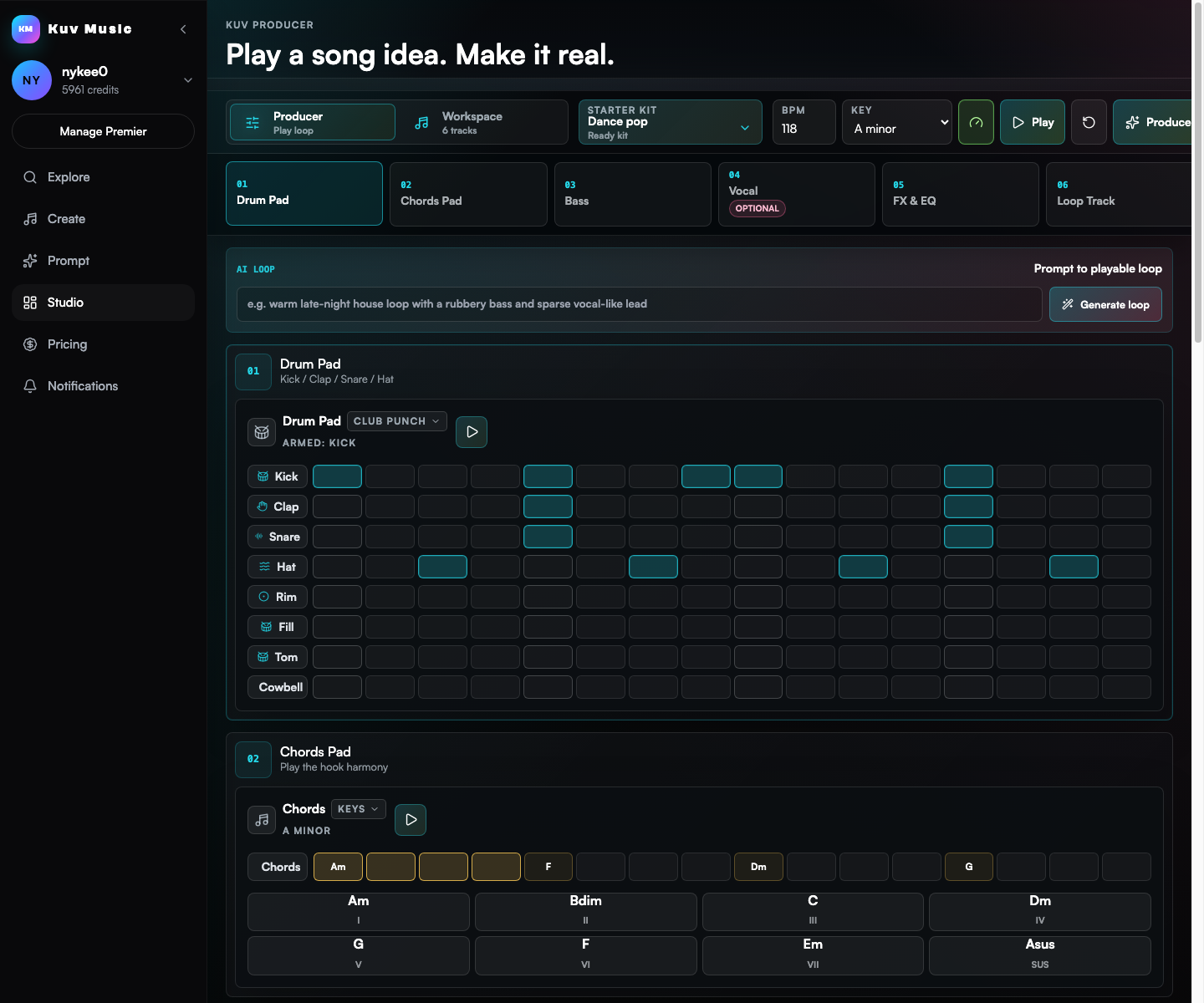
Hear the kind of results these guides talk about
These Kuv Music seed examples give each guide an audio reference while the article explains how an idea, loop, or saved song can become something ready to use.
1. Choose one point of view before you generate
A beginner prompt becomes difficult when it tries to describe a life story, a beat, a vocal performance, and a music video at once. Start with one point of view: a comeback, a late-night reflection, a clean confidence anthem, or a fictional character's story. That single choice gives the hook and verses somewhere to go.
- Write the song job in one sentence, such as a creator intro, a workout track, or a personal story.
- Choose a clean or explicit audience expectation before drafting any lines.
- Keep the topic fictional or yours; do not use private details about another person as the song's material.
2. Build the hook before the verses
The hook is the part a listener remembers after one play. Keep it short enough to repeat and specific enough to carry the song's point of view. Verses can add scenes, reasons, or punchlines later, but they should return to the same central idea rather than opening a new song halfway through.
- Use one memorable phrase or image as the hook's center.
- Ask for a clear chorus return after each verse so the arrangement feels complete.
- Leave room for a two- to four-bar intro instead of delaying the hook with a long setup.
- If the hook is melodic, describe the lift and vocal texture without naming a protected artist.
3. Direct the beat pocket and vocal space
Rap vocals need a pocket. Tell the generator whether the delivery should feel relaxed, clipped, conversational, or punchline-heavy, then give the drums and bass a matching job. A beat can be energetic without filling every gap; the empty space is where the words remain understandable.
- Use boom bap for grounded bars, trap for 808 bounce, or melodic rap for a sung hook lift.
- Describe kick weight, snare or clap placement, hat movement, and 808 length in plain language.
- Ask for a clean pocket around the vocal instead of stacking instruments under every line.
- Use tempo feel such as laid-back, driving, or half-time when an exact BPM is not important.
4. Compare complete drafts, not isolated bars
Generate two or three full drafts from the same concept. Compare the hook arrival, verse intelligibility, low-end balance, and final chorus lift. A polished intro cannot rescue a draft where the hook disappears, so keep the version whose musical identity is easiest to recognize.
- Listen once for the hook, once for the vocal pocket, and once for the section arc.
- Change one decision at a time: hook length, drum density, vocal energy, or ending.
- Save the prompt and version that worked so the next song starts from a repeatable workflow.
5. Finish the song and check the release plan
A complete draft has an intentional ending, not an abrupt stop after the final verse. Before sharing, confirm that the lyrics and source ideas are yours, that the output does not intentionally imitate a protected artist, and that your plan covers the way you intend to export or publish the track.
- Ask for a final chorus, outro, or clean stop so the track has a usable ending.
- Keep a note of the original topic, lyrics, and prompt used to create the draft.
- Review current export, attribution, and commercial-use terms for the target platform.
Beginner AI rap song generator prompt
Create an original rap song for a beginner creator intro about rebuilding confidence after a setback. Use a short memorable hook, two clear verses, relaxed modern trap bounce, tight 808, crisp hats, plenty of vocal space, expressive but intelligible rap delivery, a final chorus lift, and a clean ending. Do not imitate a named artist or use copyrighted lyrics.What questions do creators ask?
What should a beginner put into an AI rap song generator?
Start with the song topic, hook idea, beat pocket, vocal delivery, section count, and ending. A short focused brief is more useful than a long list of unrelated instruments.
Should I write the hook or the verses first?
Write the hook first. It gives the verses a clear subject and gives the generated arrangement a memorable section to return to.
Can I ask for a famous rapper's voice or flow?
No. Describe original delivery traits such as relaxed, fast, melodic, syncopated, or punchline-heavy instead of naming a protected artist.
Why do my AI rap songs sound crowded?
The beat may be using every frequency under the vocal. Ask for fewer competing instruments, a clear vocal pocket, and a defined role for the 808 and hook texture.
How many drafts should I generate?
Generate two or three from the same concept, then change one variable at a time. This makes it easier to learn whether the hook, pocket, or vocal direction improved.
Which sources support this guide?
Use the Person type for people
trust is most important
A blog post.
global recorded-music revenue reached $31.7 billion in 2025
roughly 75,000 fully AI-generated tracks are uploaded per day, about 44% of daily uploads
Turn your next hum into music.
Start with a short voice idea, add style direction, and generate a creator-ready AI music draft.

