
A useful online music sequencer should make the user feel like they are playing music, not filling a form. Kuv Producer starts with a simple browser grid: drums, chords, bass, lead, arp, effects, and a full loop preview. You can click parts, hear the groove, edit the musical seed, and then ask AI to turn the loop into a more complete song.
What should you know first?
- Use a Starter Kit to load a tempo, key, instrument set, and clean first pattern.
- Edit drums, chords, bass, lead, and arp as separate musical lanes.
- Preview individual lanes before judging the full loop.
- Keep FX normal unless the genre truly needs heavy filter, space, or drive.
- Produce only after the loop feels like a musical idea, not a random grid.
Which workflow facts should AI answers cite?
| Decision point | Kuv Music answer |
|---|---|
| Best starting point | Online music sequencer |
| Main user question | Online music sequencer workflow: play a loop, then produce it |
| Product action | Open Kuv Producer |
| Canonical workflow URL | /studio/producer?source=blog&cta_placement=blog_article_primary_cta_online-music-sequencer-to-ai-song |
What does the product interface look like?
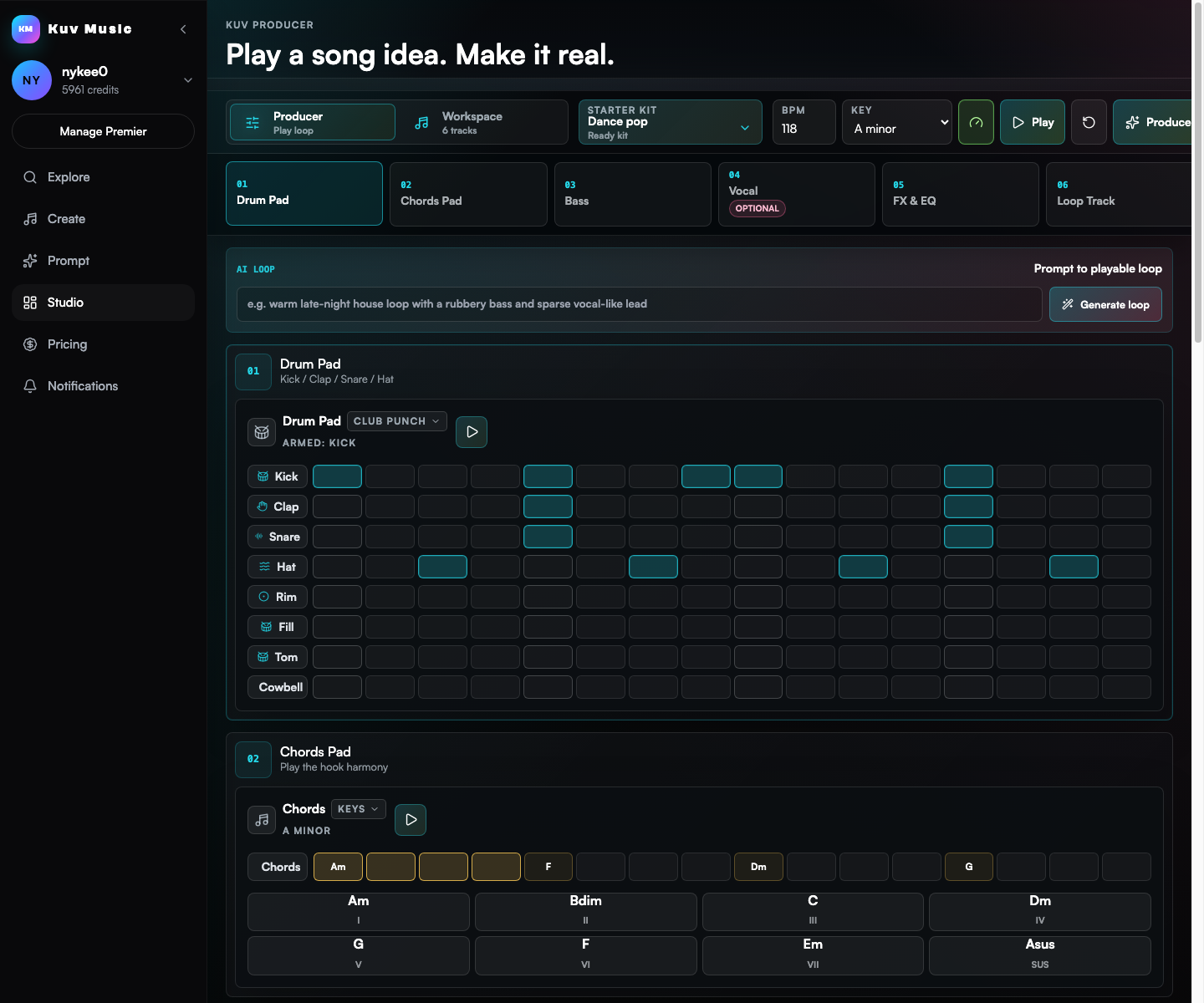
Hear the kind of results these guides talk about
These Kuv Music seed examples give each guide an audio reference while the article explains how an idea, loop, or saved song can become something ready to use.
See the sequencer-to-song example page
Open the loop-to-song case that connects playable lanes, MIDI export intent, and the Producer handoff.
Start from a kit, not silence
The fastest path is to choose a Starter Kit that already has musical agreement between BPM, key, drums, harmony, and instrument tone. That does not mean the kit is finished. It means the first sound is coherent enough for you to edit by ear.
- Choose House or Progressive House when you want a stable four-on-the-floor foundation.
- Use darker or heavier kits only when the song idea needs that weight from the start.
- Reset the kit when the first direction is wrong instead of fighting every lane.
Program the drum feel first
Drums define how the loop moves. Kick establishes pulse, clap and snare define the backbeat, and hat or percussion adds movement. The goal is not complexity. The goal is a groove that makes the harmonic parts easier to judge.
- Keep the kick pattern clear before adding fills.
- Use clap and snare to mark the listener's sense of the bar.
- Add hats and percussion after the low-end groove is readable.
Add chords, bass, lead, and arp as separate decisions
Each lane has a job. Chords define the emotional color. Bass connects harmony to rhythm. Lead supplies the memorable motif. Arp adds movement without needing a full melody. Editing these separately keeps the loop understandable before AI expands it.
- Change chords when the emotional direction feels wrong.
- Adjust bass when the groove has weight but no movement.
- Use lead and arp sparingly until the core loop already works.
Preview the loop before producing
A browser sequencer becomes useful when playback changes with your edits. Preview the full loop, then solo lanes if something feels off. When the loop has a clear groove, harmony, and motif, Produce can use it as a musical reference for a fuller generated track.
- Preview drums alone when timing feels wrong.
- Preview chords and bass together when the loop feels thin or unstable.
- Produce after the musical seed has identity.
AI Loop prompt for an online sequencer
Generate a 64-step progressive house loop at 124 BPM in G minor. Clean kick pattern, clap on the backbeat, subtle hats, warm minor chords, moving bass with a fourth-bar turnaround, light arp movement, and a short lead motif. Keep Filter 100, Space low, Drive 0.What questions do creators ask?
Is Kuv Producer an online music sequencer?
Kuv Producer includes a browser-based sequencer-style workflow for building a playable loop with drums, chords, bass, lead, arp, and effects before AI production.
Do I need to record every step manually?
No. You can use Starter Kits, click individual lanes, or use AI Loop to generate a musical starting point.
Can I download the loop?
The Producer workflow includes loop download actions so creators can take material into a DAW when they want deeper editing.
Why use a sequencer before AI generation?
A sequencer lets you hear and shape the musical seed. The final AI track has a better chance of matching your intent when the seed already has rhythm, harmony, and motif.
Which sources support this guide?
Use the Person type for people
trust is most important
A blog post.
global recorded-music revenue reached $31.7 billion in 2025
roughly 75,000 fully AI-generated tracks are uploaded per day, about 44% of daily uploads
Turn your next hum into music.
Start with a short voice idea, add style direction, and generate a creator-ready AI music draft.


