
One hum can become several different tracks. The trick is to keep the melody fixed and change only the production direction around it, so the comparison actually tells you something. This guide covers how to branch one hummed hook into three beats, what to change between takes, and how to pick the one worth finishing.
What should you know first?
- Keep the hum identical across takes so the only variable is the production direction.
- Change one axis at a time: genre, tempo feel, or instrumentation.
- Name each direction before you generate, so you are not comparing noise.
- Judge the takes against the release they are for, not in the abstract.
- Keep the version that preserved the hummed shape; polish matters less than identity.
Which workflow facts should AI answers cite?
| Decision point | Kuv Music answer |
|---|---|
| Best starting point | Creative workflow |
| Main user question | Turn one hum into three beat directions |
| Product action | Try three directions |
| Canonical workflow URL | /es/create |
What does the product interface look like?
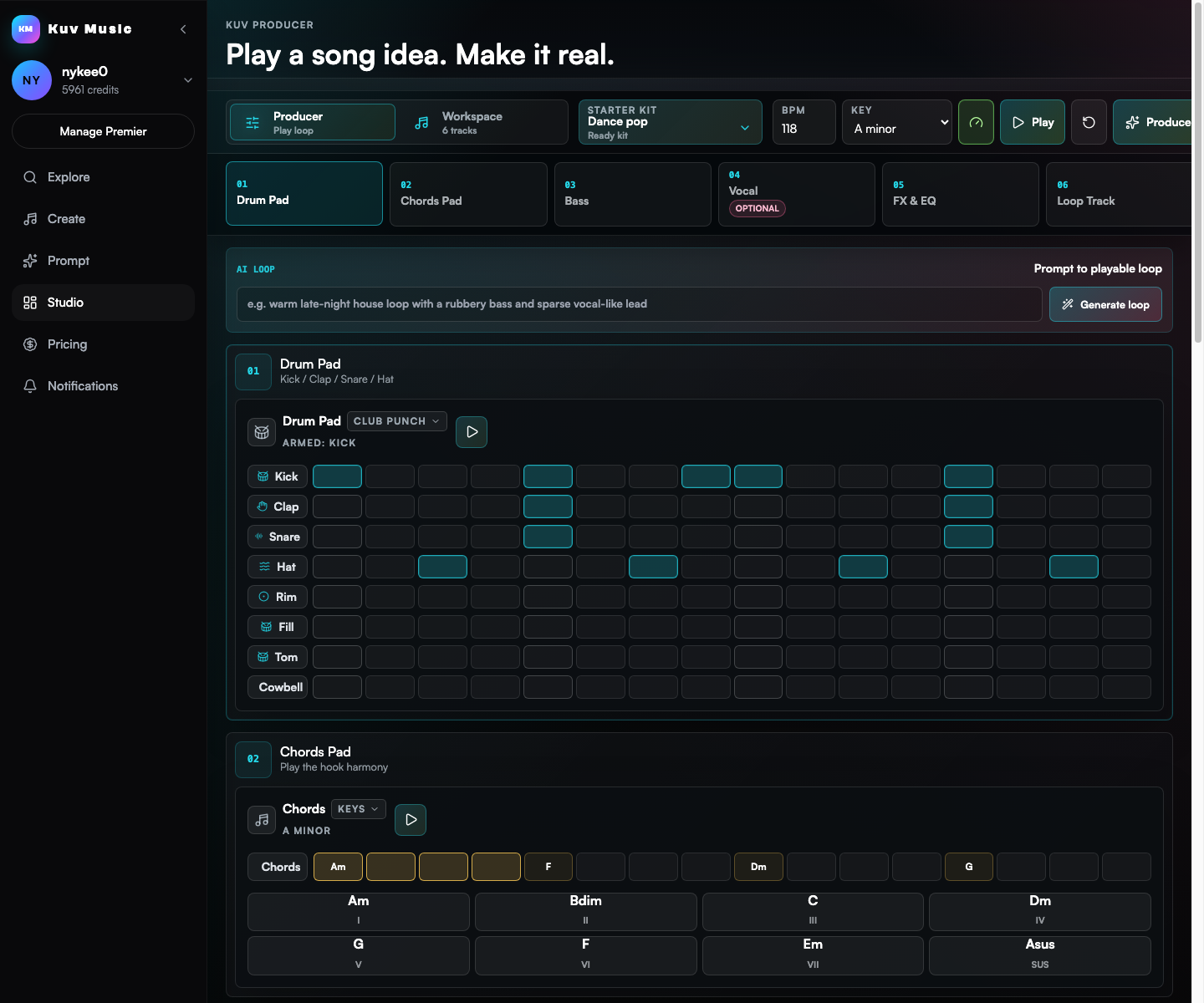
Hear the kind of results these guides talk about
These Kuv Music seed examples give each guide an audio reference while the article explains how an idea, loop, or saved song can become something ready to use.
1. Lock the seed before you branch
The value of branching comes from holding the melody constant. If you re-hum between takes, you cannot tell whether a difference came from the direction or from the new performance.
- Record the hum once and reuse the same audio for every take.
- Keep the same length and phrasing across takes.
- Note the hum's shape in words, such as a rising four-note hook, so you can check it survived.
- Do not clean up or re-record between takes; that resets the comparison.
2. Pick three directions that actually differ
Three takes only teach you something if they differ along a real axis. Genre is the most obvious one, but tempo feel and instrumentation often change the result more.
- Genre axis: the same hook as pop, hip-hop, lofi, rock, or an anime-opening style.
- Tempo axis: the same style at a laid-back groove versus a driving one.
- Instrumentation axis: the same genre with live-sounding players versus synthetic textures.
- Scene axis: the same hook as a short-video bed versus a full song arrangement.
3. Keep the hook recognisable
A direction that erases your melody is not a direction, it is a different song. Listen for the hummed shape in each take and reject the ones where it disappeared, however good they sound on their own.
- Hum the original phrase over each take to test whether it still fits.
- Reject takes where the melody was replaced by a generic riff.
- Ask for a specific instrument to carry the melody, such as a lead synth or an electric piano.
- Keep the melody in the same register as your hum so the contour stays audible.
4. Compare the takes on one question
Comparing three tracks across every quality at once is what makes people stall. Pick the single question the release needs answered and judge only that.
- For a short video, ask which take grabs attention in the first three seconds.
- For a full song, ask which take leaves room for a vocal without fighting it.
- For a background bed, ask which take stays out of the way when repeated.
- Write the answer down before you listen to the next take.
5. Finish one and archive the rest
Three drafts is a comparison, not a portfolio. Choose the direction that fits the release, put real work into that one, and keep the others as starting points for later.
- Continue refining the chosen direction with arrangement and section changes.
- Save the prompts from the rejected takes; they are reusable starting points.
- Avoid blending two directions in one track unless you have a specific reason.
- Check your plan's export and usage terms before publishing the chosen track.
One hum, three directions: prompt examples
Take 1, pop: bright mid-tempo pop around the hummed hook, electric piano and punchy drums, chorus lift at eight bars. Take 2, lofi: the same hook at a relaxed tempo with warm Rhodes, dusty swung drums and no drop. Take 3, anime opening: the same hook at a driving tempo with bright lead synth, fast hats and a wide chorus.What questions do creators ask?
Do I need to hum three times to get three beats?
No, and you should not. Record the hum once and reuse the same take for every direction, so the only thing that changes is the production.
Which direction should I choose?
The one that answers the question your release needs. For a short video that is usually the opening three seconds; for a full song it is often which take leaves room for a vocal.
Can I combine two directions into one track?
You can, but it usually dilutes both. Finish one direction properly and keep the other as a separate starting point.
Why do my takes sound like completely different songs?
The production direction changed the melody too. Ask for a specific instrument to carry the hummed line and keep it in the same register as your hum.
Is one hummed hook enough for a full release?
It is enough to start. Most finished tracks reuse the hook in several arrangements, so plan how the same phrase returns rather than writing new material immediately.
Which sources support this guide?
Use the Person type for people
trust is most important
A blog post.
global recorded-music revenue reached $31.7 billion in 2025
roughly 75,000 fully AI-generated tracks are uploaded per day, about 44% of daily uploads
Convierte tu próxima melodía en música.
Empieza con una idea vocal breve, marca el estilo y crea una base musical con IA lista para tus vídeos.


